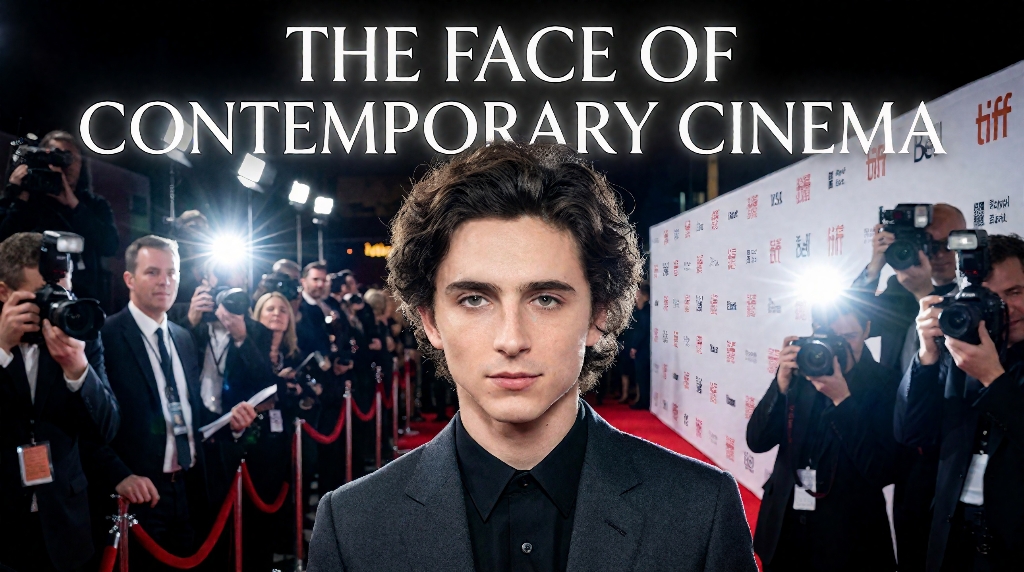
Timothée Chalamet didn’t arrive in Hollywood the way stars traditionally do. There was no gradual acclimation period, no phase where the industry tried to mold him into something familiar. He appeared almost fully formed—specific, intentional, and strangely out of step with what male stardom had long demanded. It wasn’t explosive. It was disruptive in a quieter, more unsettling way.
From the beginning, Chalamet felt less like a discovery and more like a correction. A response to something audiences didn’t realize they were missing until he showed up.
Precision Over Popularity
What separated Chalamet early wasn’t just talent—it was selectivity. His roles didn’t chase validation or mass appeal. Instead, they circled emotional interiority, ambiguity, youth that felt unresolved rather than aspirational. These were characters shaped by hesitation, longing, confusion—states rarely centered in male leads without irony or punishment.
That choice alone marked a departure from precedent. Hollywood has historically rewarded clarity in men: confidence, decisiveness, control. Chalamet leaned into the opposite without turning it into fragility theater. His performances didn’t ask for sympathy. They asked for attention.
There’s a discipline in that restraint. Vulnerability only works on screen when it’s contained. Chalamet understood that early.
Masculinity, Rewritten Without Announcement
Chalamet never announced a redefinition of masculinity. He didn’t frame his work as a statement or a challenge. He simply performed masculinity differently—less armored, more porous, still credible.
This distinction matters. The characters he plays are rarely passive. They’re active in thought, desire, and conflict, even when they lack direction. That subtlety resonated with audiences who grew up watching masculinity framed as dominance or detachment. Chalamet offered an alternative that felt contemporary rather than corrective.
He didn’t reject strength. He relocated it.
The Intelligence of Restraint
Many young actors mistake momentum for inevitability. Chalamet didn’t. His career choices reflect an understanding that early acclaim can be as dangerous as obscurity. Instead of accelerating into repetition, he created spacing between projects. He allowed time for recalibration—for audiences to reset expectations.
This patience is rare in a culture driven by constant presence. It suggests a long-term view not often associated with youth. Chalamet appears acutely aware that overexposure dulls intrigue, and that credibility compounds slowly.
When he entered franchise territory, he did so selectively. Not as a default, but as an extension of a broader strategy—working with directors whose visions carried weight, ensuring scale didn’t erase specificity.
Fame as a Side Effect, Not a Goal
There’s a noticeable difference between celebrities who crave visibility and those who manage it. Chalamet falls firmly in the latter category. He doesn’t attempt to flatten himself for accessibility. He doesn’t explain every choice or narrate his own evolution.
Public appearances feel deliberate, not habitual. Interviews reveal thoughtfulness but retain boundaries. He allows enough transparency to feel human, but not enough to become consumable.
That distance isn’t detachment. It’s containment. In an era where celebrity often collapses into over-sharing, Chalamet’s refusal to fully demystify himself feels almost radical.
Fashion as Cultural Literacy
Chalamet’s fashion choices are frequently described as bold, but boldness misses the point. What he demonstrates instead is fluency. He understands how clothing functions as narrative—not as spectacle, but as subtext.
His style disrupts expectations without demanding approval. There’s no accompanying manifesto, no justification. The clothes appear, exist, and move on. That confidence communicates something subtle but powerful: identity doesn’t need defense.
Importantly, fashion never overtakes his work. It complements the persona without replacing it. That balance is difficult to maintain, and many fail at it. Chalamet hasn’t.
Industry Trust and Professional Gravity
Hollywood’s response to Chalamet reveals another dimension of his rise: trust. Directors return to him. Studios invest in him. Critics treat his performances with seriousness rather than novelty.
This level of institutional confidence doesn’t materialize from hype alone. It’s built on preparation, collaboration, and reliability. Chalamet has cultivated a reputation for showing up ready—not just emotionally, but intellectually. He engages with material. He understands context.
That reliability makes him less replaceable. And in an industry built on replacement, that distinction matters.
Youth Without Recklessness
There’s an interesting paradox at the center of Chalamet’s career: he became respected very young. That respect narrowed his margin for error. Instead of rebelling against it, he adapted to it.
His experimentation is measured. He stretches into new territory without dismantling the foundation beneath him. Some interpret this as caution. It’s better understood as foresight.
Longevity in cinema doesn’t belong to those who reinvent themselves annually. It belongs to those who maintain coherence while evolving gradually. Chalamet seems aware of this—willing to move slowly in a system that rewards speed.
Cultural Timing and Emotional Accuracy
Chalamet’s ascent aligns with a broader cultural shift. Audiences have grown skeptical of grandiosity and uninterested in invincibility. They gravitate toward specificity—toward performances that feel emotionally accurate rather than theatrically impressive.
Chalamet fits this moment precisely. Not because he reflects it, but because he understands it. His work doesn’t lecture or perform relevance. It listens.
That listening quality is perhaps his most underrated strength. He absorbs cultural mood and responds with nuance rather than exaggeration.
A Star Built for Endurance
If early stardom is about visibility, sustained stardom is about control. Chalamet appears to understand the difference. He doesn’t chase saturation. He builds continuity. Each role feels connected, even when the genres shift.
There’s a sense that he’s constructing something cumulative—a career that makes sense when viewed in total rather than in fragments. That architectural thinking separates temporary success from lasting presence.
The Quiet Power of Not Rushing
Perhaps the most defining trait of Timothée Chalamet’s career is his refusal to hurry. In an industry obsessed with immediacy, he chooses pacing. In a culture addicted to explanation, he allows ambiguity.
That patience reads as confidence. Not the loud kind, but the grounded kind—the kind that doesn’t need constant reinforcement.
It’s why discussions around Chalamet often extend beyond individual performances. He’s not just evaluated as an actor, but as a model for how stardom might function in a more reflective era.
What He Ultimately Represents
Timothée Chalamet doesn’t represent the future of Hollywood so much as its recalibration. A reminder that intensity doesn’t require excess, that masculinity can be complex without being performative, and that visibility is most powerful when it’s controlled.
His influence isn’t loud. It’s cumulative. And that may be why it lasts.
Years from now, when careers shaped by speed have burned out, Chalamet’s will likely still be unfolding—layer by layer, choice by choice, without urgency.
Exactly as intended.
- Paul Mescal: The Quiet Intensity Behind a Modern Actor’s Rise
- Tyla: The Global Rise of a Star Who Moves to Her Own Rhythm
- Jacob Elordi: The Quiet Transformation of a Modern Leading Man
- Kanye West: Genius, Disruption, and the Complicated Legacy of a Cultural Architect
- Sabrina Carpenter: The Long Game of Becoming Unavoidable