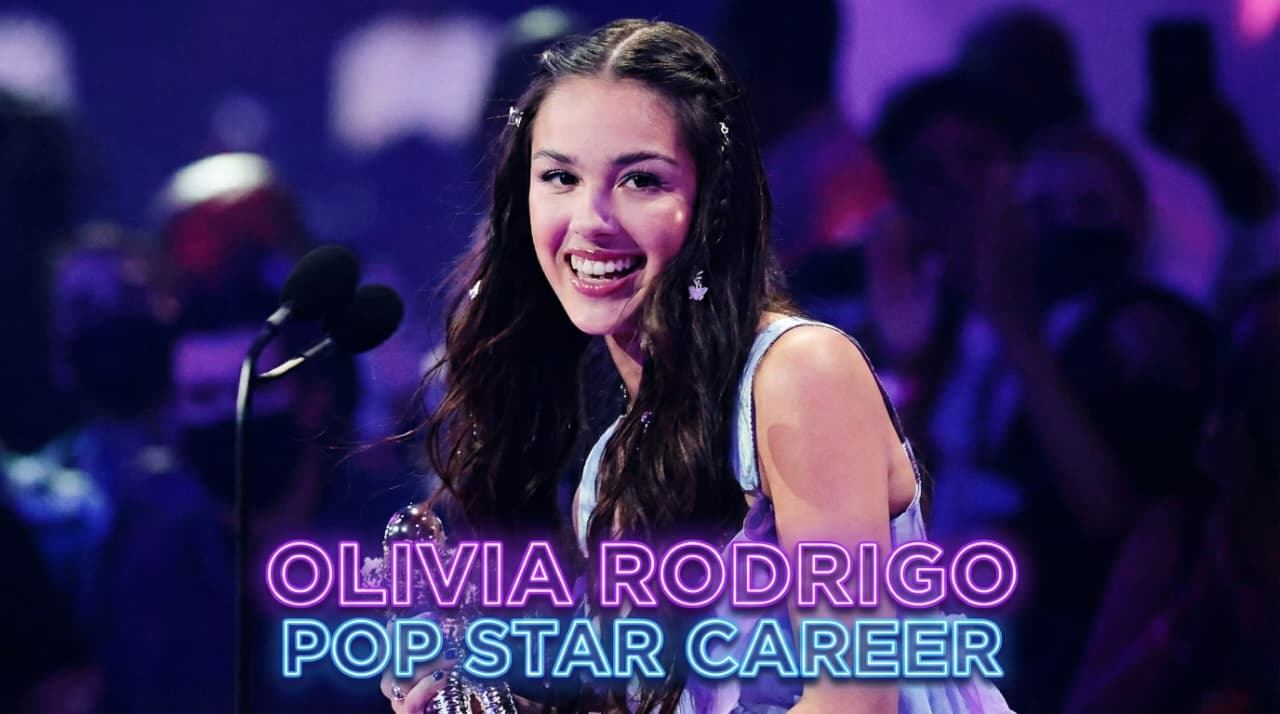
There’s something almost disarming about Olivia Rodrigo’s rise. Not because it happened slowly—it didn’t—but because it happened honestly. In an industry built on polish, personas, and perfectly engineered pop moments, Rodrigo arrived sounding like someone who hadn’t yet learned how to hide what she was feeling. And that, more than anything, is why she landed so hard.
Her songs didn’t feel like singles designed for radio. They felt like pages torn from a notebook. Messy, specific, occasionally dramatic, and painfully recognizable.
From Disney Frames to Center Stage
Before the charts, before the Grammys, before the think pieces, Olivia Rodrigo was known to a very specific audience: kids and teens watching Disney Channel. She acted, she sang, she did what young performers have done for decades—learned how to hit her marks and stay likable.
But when she stepped into music on her own terms, the tone shifted immediately.
“drivers license” didn’t sound like a debut engineered by a committee. It sounded like a late-night confession that accidentally went viral. The song wasn’t subtle, and it wasn’t trying to be. It named feelings most pop songs circle around but rarely sit inside: jealousy, heartbreak, humiliation, longing. It trusted the listener to keep up.
They did.
The Power of Specific Emotion
One of Rodrigo’s quiet strengths is specificity. She doesn’t write breakup songs in broad strokes. She writes about streets you can picture, moments you’ve lived, emotions you’d rather forget. That level of detail creates a strange intimacy—listeners don’t just hear her songs, they enter them.
This approach makes her music feel less like performance and more like shared experience. Even people far removed from teenage heartbreak recognize the emotional truth underneath. That’s not an accident. It’s instinct paired with sharp songwriting intelligence.
Fame Without the Distance
As her visibility exploded, something interesting happened: Olivia Rodrigo didn’t immediately retreat behind irony or detachment. She stayed earnest longer than most artists at her level. She talked openly about insecurity, pressure, and the whiplash of sudden fame. There was no rush to present herself as untouchable.
That openness made her relatable—but it also made her vulnerable.
Being emotionally transparent in public means people feel entitled to your interior life. Rodrigo has had to learn, in real time, where expression ends and self-protection begins. You can hear that evolution in her later work: the edge sharpens, the anger speaks up, the sweetness gets teeth.
Growth Without Erasure
What separates Rodrigo from many “former teen stars” is that she hasn’t tried to erase who she was to prove who she’s becoming. Instead, she’s letting contradiction exist. Vulnerable and biting. Romantic and resentful. Soft-spoken and unafraid to call things out.
That balance shows maturity—not the performative kind, but the earned kind.
Her music has grown more confident, more confrontational, but it hasn’t lost its emotional center. If anything, it’s become more self-aware. She’s no longer just documenting heartbreak; she’s interrogating it.
A Voice for a Generation—Without the Label
People are quick to label Olivia Rodrigo as “the voice of Gen Z.” She doesn’t seem particularly interested in carrying that title. And that may be why it fits.
She isn’t trying to speak for a generation. She’s speaking from within it. Her lyrics don’t offer answers. They ask questions. They sit in confusion. They admit contradictions. That honesty resonates in a cultural moment where certainty often feels fake.
Rodrigo’s appeal isn’t about rebellion or image. It’s about recognition. Listeners hear her and think, someone else feels this too.
Navigating the Industry Without Losing the Thread
The music industry has a way of smoothing out edges, especially when success comes early. So far, Rodrigo has resisted that flattening. Her choices—sonically and publicly—suggest someone paying attention to the long game.
She collaborates carefully. She speaks selectively. She doesn’t oversaturate her presence. Each release feels intentional, not obligatory. That restraint is rare, especially for artists whose demand could easily justify constant output.
It’s a sign of confidence, but also of awareness. She seems to understand that longevity isn’t built on constant visibility—it’s built on trust.
Where She Stands Now
Olivia Rodrigo is no longer just a breakout star. She’s in the more complicated phase: sustaining relevance without calcifying into a version of herself she no longer recognizes. That’s the real test.
So far, she’s meeting it by staying close to what made people care in the first place—emotion, honesty, and a willingness to sound imperfect. She hasn’t outgrown vulnerability. She’s learned how to wield it.
And that may be the most compelling part of her story: not how fast she rose, but how deliberately she’s choosing who she becomes next.